

Twilight is not one colour. It is a sequence, and the pink and purple stage is the one most people miss because it arrives after the sun has already gone. By then, the light reaching your eyes has travelled a very long way through the upper atmosphere and been stripped of almost everything except the reds, blues and violets. Understanding that process makes the show easier to predict — and much easier to be standing in the right place for.
What scattering actually does
Sunlight looks white but contains every colour. When it enters the atmosphere it collides with molecules of nitrogen and oxygen that are far smaller than the wavelength of visible light. This is Rayleigh scattering, and it does not treat colours equally: short wavelengths — violet and blue — are flung around the sky far more vigorously than the long ones, orange and red.
At midday the sun is high and its light passes through a comparatively thin slice of atmosphere. Blue is scattered in every direction, including towards your eyes, so the sky looks blue. At sunset the geometry changes completely, and so does the colour you see.
The long way round
When the sun sits near the horizon, its light enters the atmosphere at a shallow angle and travels a much longer path to reach you — many times the distance it covers at noon. Most of the blue is scattered away before it arrives, leaving what survives as orange, then red. That is the colour of the low sun itself and of the light it throws onto the undersides of clouds.
The important part for twilight comes next. Once the sun has dropped below the horizon you cannot see it, but its light is still striking the atmosphere many kilometres above your head, and that illuminated air scatters light down to you. So the glow continues without the sun. As it sinks further, the lit layer moves higher and the light reaching it has passed through even more air. The oranges fade, the reds deepen, and eventually the only bright thing left is a narrow band low in the west.
Where the pink, magenta and violet come from
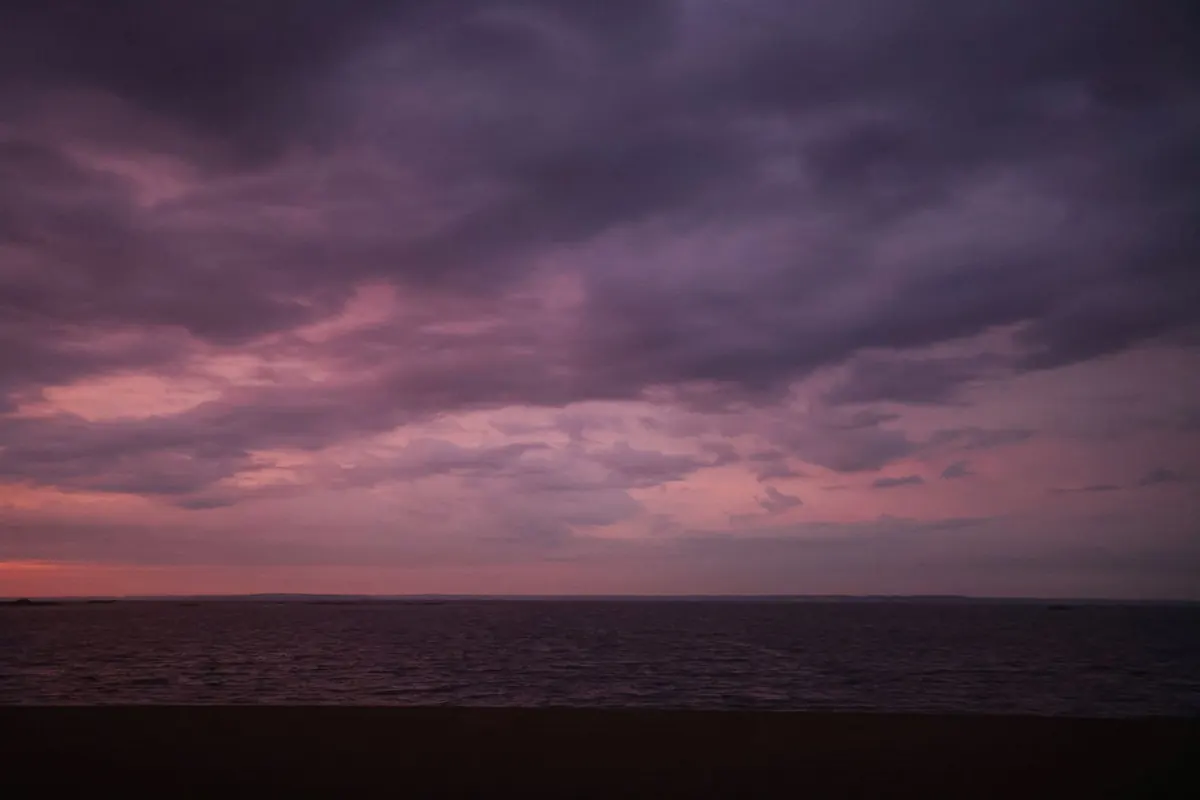
Pink and purple appear when two different populations of light mix. On one side you have warm reds and oranges that have come through the lower, dustier air along the sun's line of sight. On the other you have blue light still being scattered out of the upper sky. Where those overlap — often in a band above the orange, or across a sheet of high cloud — you get pink first, then magenta, then the deep violet of the last light. Photographers call the tail end of this the blue hour, though the colour is usually closer to indigo.
There is a second contributor much higher up. Ozone in the stratosphere absorbs some of the yellow and red passing through it, which leaves the very high twilight sky with a violet-blue tinge rather than pure blue. On a clear evening you can sometimes see the colour shift from warm at the horizon to cold purple overhead in a single sweep.
Clouds are the canvas
Colour in the sky is invisible unless something reflects it, and cloud does that job at different times depending on how high it sits.
High cloud
Cirrus and cirrostratus, roughly five to ten kilometres up, catch sunlight longest. They stay lit well after the ground has gone dark and give you the streaked pinks and golds that most people picture when they think of a good sunset.
Mid-level cloud
Altocumulus — the patchy "mackerel sky" — is the classic twilight cloud. It is thick enough to hold colour and broken enough to let light through the gaps, which is why an evening with scattered mid-level cover often beats a completely clear one.
Low cloud
Anything below about two kilometres goes grey early and turns into silhouette. A solid low deck can kill the whole show, though a ragged low layer with a clear strip of horizon beneath it gives you the contrast that makes colour look stronger.
A few colour clues are worth remembering:
- Amber or gold just above the horizon — the sun is still close to setting.
- Salmon pink on high cloud — the light has travelled a long way and the sun is well below the horizon.
- Magenta and deep violet — you are in mixed scattering, near the end of the show.
- A dark blue-grey band beneath the pink — that is the Earth's shadow, not cloud.
- Flat grey cloud — it is too low to be lit, and the colour is happening above it.
The Belt of Venus and the rising shadow
Turn your back on the sunset about ten minutes after the sun disappears. Opposite it you will usually see a soft pinkish band arching across the sky — the Belt of Venus — and beneath it a darker blue-grey wedge. The pink is sunlight reddened by its long journey and scattered back towards you by air above the shadow line. The wedge below is the Earth's own shadow, projected onto the atmosphere. It climbs as the sun sinks, and watching it swallow a familiar hill or church tower is one of the quietest free spectacles going.
Why one evening beats another
Weather and season do more to change twilight than most people realise.
- A clean western horizon matters most. If low cloud or a hill blocks the sun's path to the upper atmosphere, there is no light left to scatter.
- High and mid cloud act as screens. Broken cover between roughly three and ten kilometres gives you something to catch the colour.
- Particles change the palette. Heavy haze and pollution mute the oranges but can deepen purples; cleaner air after a cold front tends to give crisper, more saturated gradients. Big volcanic eruptions that put sulphate particles into the stratosphere have produced vivid twilight colours around the world for months afterwards.
- Season sets the pace. At UK latitudes the summer sun approaches the horizon at a shallow angle, so twilight lingers and the colour changes slowly; in the far north it barely gets dark at all around midsummer. Winter twilight is compressed, the colours shifting fast in a shorter window.
Catching a better twilight: practical habits
- Check the cloud forecast, not just whether it will rain. You want a clear band above the western horizon and some broken cloud higher up.
- Arrive before sunset and stay at least forty minutes after. The best colour usually comes ten to thirty minutes after the sun has gone.
- Give your eyes time to adjust. Ten minutes without a bright screen makes a real difference to how much colour you perceive in low light.
- Turn around. Once the western sky has faded, the pink band and shadow in the east are often the better picture.
- Choose a west-facing spot with an open horizon — a hill, a seawall, a field gate — so you can see the full sweep from horizon to zenith.
- Note the time and the conditions when you get a good one. Matching that against the forecast the next evening is the quickest way to learn what your local sky does.
The forecast only tells you whether it is worth the walk. The sky does the rest.
Photo: David Kanigan / Pexels
Related posts
More stories you’ll love reading